
CR-1 vs IR-1 Visa: Complete Guide to Spouse Visa Categories
CR-1 vs IR-1 explained: the difference affects your green card type, interview focus, and post-arrival requirements. Learn which applies to your case and why.
Ready for Visa Team
If you are going through the marriage-based immigration process, you have probably run into two terms that look almost identical but carry very different implications for your future: CR-1 and IR-1. These are the two spouse visa categories under family-based immigration for married couples where one partner is a U.S. citizen and the other is a foreign national. And despite looking similar on paper, the difference between them affects your green card status, your interview experience, and what you will need to do after you arrive in the United States.
Here is what makes this confusing: you do not choose between these two categories. The one you receive is determined entirely by how long you have been married at the time your visa is issued. That single factor — the age of your marriage — determines whether you enter the U.S. with a conditional green card or a permanent one, whether you will need to file additional paperwork two years later, and even what kinds of questions the consular officer is likely to focus on during your interview.
Most couples do not fully understand this distinction until they are deep into the process, and by then, misinformation from forums and social media has already muddied the waters. Some people think the CR-1 means their marriage is being questioned. Others believe the IR-1 is somehow "better" and try to delay their case to qualify for it. Neither of these assumptions is quite right.
This guide is going to give you a clear, thorough understanding of both visa categories. By the time you finish reading, you will know exactly what each one means, how they differ in practice, what to expect during the interview for each, and what happens after you arrive. Whether you are early in the process or already preparing for your consular interview, this is the breakdown you need.
Heads up — different decision than K-1 vs CR-1. This guide assumes you have already chosen the spouse-visa path (i.e. you are legally married). If you are still deciding between the K-1 fiance visa and a marriage-based visa in the first place, start with our K-1 vs CR-1 visa guide — that is an upstream decision about whether to marry abroad first or bring a fiance to marry in the U.S. The CR-1 vs IR-1 split below only applies once you are already on the spouse-visa track.
Key Takeaways
- You don't choose CR-1 or IR-1. The category is assigned automatically based on how long you have been married on the day the visa is issued at your consular interview.
- Under 2 years married at issuance → CR-1 (2-year conditional green card, requires Form I-751 to remove conditions later). 2+ years married at issuance → IR-1 (10-year permanent green card, no I-751).
- Same petition (I-130), same processing pipeline, same fee. The only thing that differs is what the consular officer stamps at approval.
- Total processing typically 12-24 months. Couples who file early after the wedding usually get a CR-1; couples whose marriage crosses the 2-year mark during processing typically get an IR-1.
- Both paths give immediate work authorization on arrival. Both let you naturalize after 3 years of marriage to your U.S.-citizen spouse. The CR-1 simply has one extra paperwork step (the I-751) two years in.
What Is a CR-1 Visa?
The CR-1 visa stands for Conditional Resident visa. It is issued to the foreign national spouse of a U.S. citizen when the marriage is less than two years old at the time the visa is granted. The "conditional" part is the key concept here, and it is worth understanding exactly what it means.
When you enter the United States on a CR-1 visa, you receive a two-year conditional green card under the conditional permanent residence rules. This green card gives you almost all the same rights as a permanent green card holder — you can live and work anywhere in the United States, you can travel internationally, and you are on the path to citizenship. The one major difference is that your resident status is conditional, meaning it comes with an expiration date and an additional step you must complete to keep it.
Why the Condition Exists
Congress created conditional residence as a safeguard against marriage fraud. The logic is straightforward: if a marriage is relatively new (under two years) at the time the visa is issued, there is a slightly higher statistical risk that the marriage may not be genuine. The conditional period gives the government a second opportunity to verify that the marriage is real and ongoing — not just at the time of the interview, but two years later as well.
This is not a judgment on your relationship. It is a blanket policy that applies to every couple whose marriage has not yet reached the two-year mark. Plenty of deeply committed, genuinely loving couples receive CR-1 visas. The condition is about timing, not the quality of your marriage.
Who Gets the CR-1?
You will receive a CR-1 visa if your marriage is less than two years old on the date the visa is actually issued to you — which is typically the date of your consular interview, assuming you are approved. This means that even if your marriage was, say, 22 months old when you filed your I-130 petition, you could still end up with a CR-1 if the visa is issued before your second anniversary.
Example scenario: Maria and James got married in March 2025. James, a U.S. citizen, filed the I-130 petition for Maria in April 2025. After NVC processing and document submission, Maria's consular interview is scheduled for January 2026 — 10 months after the wedding. Maria receives a CR-1 visa because the marriage is less than two years old at the time of issuance.
What Happens After Arrival
Once Maria enters the United States, she receives a conditional green card that is valid for two years from the date of her admission. During those two years, she can work, travel, and live her life normally. However, within the 90-day window before the conditional green card expires, she and James must file Form I-751 (Petition to Remove Conditions on Residence) together. This is a joint filing that demonstrates the marriage is still real and ongoing. We will cover the I-751 process in detail later in this guide.
The CR-1 is not a lesser visa. It simply includes one additional step — the I-751 — that the IR-1 does not require. If your marriage is genuine and you file the I-751 on time with sufficient evidence, the removal of conditions is a routine process for most couples.
What Is an IR-1 Visa?
The IR-1 visa stands for Immediate Relative visa. It is issued to the foreign national spouse of a U.S. citizen when the marriage is two years old or older at the time the visa is granted. The IR-1 is the spouse visa category that does not come with conditions — your green card is permanent from day one.
When you enter the United States on an IR-1 visa, you receive a 10-year permanent green card. There is no conditional period, no I-751 petition to file, and no second review of your marriage. The government considers the fact that your marriage has already lasted two or more years to be sufficient evidence of its bona fide nature (at least for the purposes of the conditional residency safeguard).
Why Two Years Is the Threshold
The two-year mark is not arbitrary — it comes from the Immigration Marriage Fraud Amendments of 1986 (IMFA). Congress determined that two years was a reasonable period after which a marriage was statistically much less likely to be fraudulent. Marriages that survive two years tend to be genuine partnerships, and the government decided that requiring additional conditions beyond that point was unnecessary for most cases.
That said, receiving an IR-1 visa does not mean the consular officer will not scrutinize your marriage during the interview. They absolutely will. The bona fide requirement applies regardless of how long you have been married. The difference is simply what happens to your green card after you are approved.
Who Gets the IR-1?
You will receive an IR-1 visa if your marriage is two years old or older on the date the visa is issued. Because immigration processing can take a significant amount of time — often 12 to 24 months from petition filing to interview — many couples who were initially on track for a CR-1 end up receiving an IR-1 simply because their marriage crosses the two-year mark during processing.
Example scenario: David and Priya got married in June 2023. David filed the I-130 for Priya in August 2023. Due to normal processing times, Priya's consular interview does not take place until October 2025 — well past their second anniversary. Priya receives an IR-1 visa and enters the U.S. with a 10-year permanent green card. No conditions, no I-751.
What Happens After Arrival
After entering the United States on an IR-1 visa, you receive your permanent green card (typically mailed to your U.S. address within a few weeks). You can immediately work, travel, and enjoy all the rights of permanent residency. You become eligible to apply for U.S. citizenship through naturalization three years after your date of admission as a permanent resident, assuming you remain married to and living with your U.S. citizen spouse.
The IR-1 is the more straightforward path in terms of post-arrival requirements, but keep in mind that you did not "earn" it by having a better relationship. You got it because your marriage happened to be older than two years when USCIS and the State Department finished processing your case.
What Are the Key Differences Between CR-1 and IR-1?
Now that you understand each visa category individually, let us put them side by side. Here is a clear comparison of the most important differences.
| Feature | CR-1 (Conditional Resident) | IR-1 (Immediate Relative) |
|---|---|---|
| Marriage length at issuance | Less than 2 years | 2 years or more |
| Green card type | 2-year conditional | 10-year permanent |
| Additional filing required | Yes — I-751 petition | No |
| Work authorization | Immediate upon entry | Immediate upon entry |
| Travel rights | Same as permanent resident | Full permanent resident |
| Path to citizenship | 3 years after admission (if still married) | 3 years after admission (if still married) |
| Petition form | I-130 (same) | I-130 (same) |
| Interview required | Yes | Yes |
| Risk of status loss | If I-751 is not filed or denied | Standard permanent resident rules |
Green Card Status: Conditional vs. Permanent
This is the most significant practical difference. A conditional green card looks and functions almost identically to a permanent one in daily life. You can work for any employer, live in any state, open bank accounts, get a driver's license, and travel internationally. The difference shows up at the two-year mark when you must take action to keep your status.
A permanent green card (from the IR-1) does not require any action until it is time to renew the card itself, which happens every 10 years. The renewal is a straightforward administrative process — it does not re-examine your marriage.
Processing Timeline Differences
Here is an important nuance: the CR-1 and IR-1 go through the exact same processing pipeline. You file the same I-130 petition. It goes through the same USCIS service center. It moves to the National Visa Center (NVC) on the same track. You submit the same documents. The embassy schedules interviews the same way.
The only difference is what happens at the very end. When the consular officer approves your case, they look at your marriage date and determine which category applies. If your second anniversary has passed, it is an IR-1. If it has not, it is a CR-1. The processing timeline itself does not change based on the category.
Post-Arrival Requirements
CR-1 holders have one critical additional requirement: filing the I-751 petition within the 90-day window before their conditional green card expires. Miss this window, and you risk losing your resident status. IR-1 holders do not have this requirement.
Both CR-1 and IR-1 holders have the same general obligations as permanent residents: maintaining the U.S. as your primary residence, filing U.S. tax returns, registering for Selective Service (if applicable), and not committing crimes that could lead to deportation.
Rights and Limitations
In terms of daily life and legal rights, CR-1 and IR-1 holders are functionally identical. Both can work without restrictions, both can sponsor certain family members for immigration (though the wait times are long), and both have access to the same government benefits after applicable waiting periods. The conditional status of the CR-1 does not limit your employment options, your ability to get a mortgage, or your access to Social Security benefits.
The only real limitation of conditional status is the cloud of the I-751 filing hanging over your head — and the consequences if something goes wrong with your marriage before that filing is complete.
How Do CR-1 and IR-1 Interviews Differ?
The consular interview is required for both CR-1 and IR-1 visa applicants, and the overall format is the same. You will appear at the U.S. embassy or consulate, present your documents, and answer questions from a consular officer. However, the focus of the questions can shift depending on which category you fall into.
For a comprehensive overview of the interview process itself, see our Complete Guide to Marriage Visa Interview Preparation.
CR-1 Interview Focus: Proving a Genuine New Marriage
When a consular officer knows they are interviewing a CR-1 applicant — someone whose marriage is less than two years old — they tend to focus more heavily on establishing that the marriage is genuine and was not entered into for immigration purposes. This is not because newer marriages are automatically suspect, but because the shorter marriage duration means there is less history to draw from as evidence.
Expect questions like:
- How did you and your spouse meet? The officer wants to hear a natural, detailed account with specific memories.
- When did you decide to get married, and why? They are looking for genuine motivations, not just immigration-related reasons.
- What did your families think about the marriage? Family involvement and reactions can indicate authenticity.
- How do you communicate when you are apart? For couples who have been living in different countries, evidence of regular, ongoing communication is crucial.
- What are your plans for when your spouse arrives in the U.S.? Specific plans (where you will live, work arrangements, daily life details) show you have thought about your future together.
For CR-1 interviews, strong evidence of a bona fide marriage is especially important. Bring photographs from your wedding and time spent together, chat logs and call records, evidence of visits (flight records, passport stamps), joint financial accounts if you have them, and any other documentation that shows your relationship is real and ongoing.
IR-1 Interview Focus: Demonstrating an Established Relationship
For IR-1 applicants, the marriage is at least two years old, which means the consular officer has more history to work with. The questions may shift toward the ongoing nature of the relationship and the depth of your shared life.
Expect questions like:
- Describe your daily routine as a couple. Officers want to hear the mundane details that only a real couple would know.
- How do you handle finances together? Joint accounts, shared bills, and financial planning show an intertwined life.
- Have you met each other's families? After two or more years, officers expect deeper family connections.
- What challenges have you faced as a couple, and how did you handle them? This reveals the maturity and resilience of the relationship.
- What have you done together recently? Recent shared experiences show the relationship is active, not just something that existed on paper two years ago.
For both categories, the overarching question the officer is trying to answer is the same: is this marriage real? The difference is simply in the lens they use. For CR-1, it is "Did you marry for the right reasons?" For IR-1, it is "Is this marriage still thriving?"
You can find a detailed list of the most common questions for both categories in our article on 77 Marriage Visa Interview Questions (With Sample Answers). For a CR-1-specific question bank — including the prompts officers ask when probing a newer marriage — see our companion guide on CR-1 visa interview questions.
How to Prepare Differently
If you are a CR-1 applicant, focus your preparation on telling a compelling, honest story about how your relationship began and why you got married. Make sure you can speak naturally about the timeline of your relationship, the details of your wedding, and your plans for your future together. Bring as much evidence of the relationship as you can — photos, communication records, trip itineraries, and anything else that paints a picture of a real partnership.
If you are an IR-1 applicant, focus on demonstrating the depth and continuity of your marriage. Be ready to talk about your life together in specific, concrete terms. Have evidence of shared finances, joint leases or property, and ongoing communication during any periods of separation. Show that your marriage is not something that happened two years ago and stalled — show that it is alive and growing.
Practice Your Visa Interview With AI
Get a realistic mock interview tailored to your specific visa category — CR-1 or IR-1. ReadyForVisa's AI interviewer adapts its questions based on your marriage timeline and case details.
Start Your Free Mock InterviewHow Long Does CR-1 / IR-1 Processing Take in 2026?
One of the most stressful aspects of the spouse visa process is the uncertainty around timing. Processing times fluctuate based on USCIS workload, NVC backlogs, and embassy scheduling capacity. You can check current wait times on the USCIS processing times page. Here is a realistic picture of what to expect in 2026.
Current Processing Overview
The spouse visa process involves several stages, each with its own timeline:
I-130 Petition (USCIS): This is the first step, where the U.S. citizen spouse files the petition establishing the qualifying relationship. As of early 2026, I-130 processing times for immediate relatives typically range from 8 to 14 months, though this varies by service center. Some cases are processed faster, and some take longer.
National Visa Center (NVC): After USCIS approves the I-130, the case is forwarded to the NVC. Here, you will submit supporting documents (including the DS-260 immigrant visa application, financial evidence, and civil documents). NVC processing usually takes 2 to 4 months once all documents are submitted, though this stage can take longer if there are requests for additional evidence or if documents need to be resubmitted.
Embassy Interview Scheduling: After NVC completes its review, the case is forwarded to the appropriate U.S. embassy or consulate for interview scheduling. Wait times for interview appointments vary dramatically by embassy — some schedule interviews within a few weeks, while others have backlogs of several months.
Total Timeline
From start to finish, most couples should expect the CR-1/IR-1 process to take approximately 12 to 24 months. Some cases move faster (particularly for couples with straightforward documentation and embassies with shorter wait times), and some take longer (especially if there are Requests for Evidence, administrative processing, or embassy-specific delays).
How Timing Affects Your Visa Category
Here is where the timeline becomes directly relevant to the CR-1 vs. IR-1 distinction. If your marriage is relatively new when you file the I-130, a longer processing time could actually work in your favor — your marriage may cross the two-year threshold during processing, resulting in an IR-1 visa instead of a CR-1.
For example, if you got married and filed the I-130 six months later, and the entire process takes 18 months, your marriage will be approximately two years old by the time of your interview. Whether you get a CR-1 or IR-1 will depend on the exact dates.
Conversely, couples who file very quickly after marriage and whose cases are processed relatively fast will almost certainly receive a CR-1. This is perfectly fine — the CR-1 is not a worse outcome, just a different one with one additional step down the road.
Which One Do You Get? Can You Choose?
The short answer is: you do not choose. The visa category is determined automatically based on the length of your marriage at the time the visa is issued. You file the same I-130 petition regardless, and the same processing pipeline applies. The consular officer determines your category at the time of the interview.
The Two-Year Threshold
The rule is simple: if your marriage is less than two years old on the date your immigrant visa is issued (typically the date of your approved consular interview), you receive a CR-1. If it is two years or older, you receive an IR-1. There is no application, no request, and no separate form. The officer checks the date.
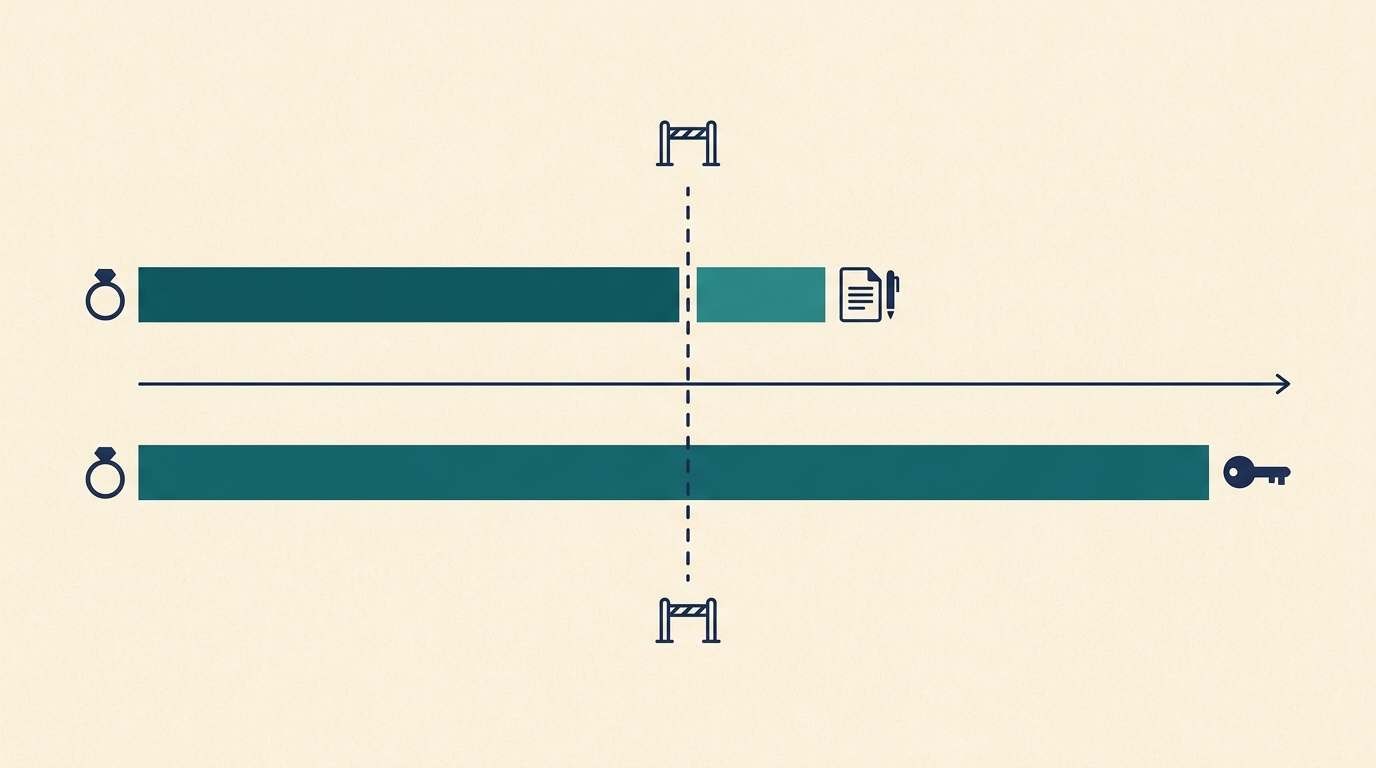
Both paths begin at the wedding (ring icon) and run through the same I-130 / NVC / interview pipeline. The dashed line marks the 2-year threshold. Marriages issued before it (top) get a CR-1 plus a later I-751 paperwork step (lighter segment). Marriages issued after it (bottom) get an IR-1 — full permanent residency on arrival, no I-751.
Strategic Timing Considerations
Some couples, aware of this distinction, consider timing strategies to influence which category they receive. These strategies include:
Delaying the petition filing. Some couples wait to file the I-130 until they are closer to the two-year mark, hoping that by the time the case is processed, they will qualify for an IR-1. This can work, but it also means extending the period of separation.
Delaying marriage itself. In rare cases, couples who have been in a long relationship but are not yet married may consider timing their wedding strategically. However, this only makes sense if you would be getting married around that time anyway.
Requesting a later interview date. This is generally not advisable and not always possible. Embassies schedule interviews based on their own capacity and case flow. Requesting a delay can introduce complications and there is no guarantee of a specific date.
Here is our honest advice: do not let the CR-1 vs. IR-1 distinction drive major life decisions. If you are ready to get married, get married. If you are ready to file the petition, file it. The I-751 process for CR-1 holders is well-established, routine, and manageable. Delaying your petition by months or years just to avoid filing one additional form later is rarely worth the additional time spent living apart.
The cost of separation — emotional, financial, and practical — almost always outweighs the administrative convenience of avoiding the I-751. File when you are ready, prepare well for whichever interview you get, and deal with the I-751 when the time comes.
CR-1 to Permanent Resident: The I-751 Process
If you enter the United States on a CR-1 visa, the I-751 petition is the final step in securing your permanent resident status. Understanding this process ahead of time will save you stress and help you stay organized.
When to File
You must file the I-751 within the 90-day window before your conditional green card expires. Your conditional green card is valid for two years from the date you were admitted to the United States (not the date of your wedding or your interview, but the date you entered the U.S.). USCIS will not accept the petition if you file it too early or too late.
For example, if you entered the United States on March 15, 2026, your conditional green card expires on March 15, 2028. Your filing window opens on December 15, 2027 (90 days before expiration) and closes on March 15, 2028.
Filing Jointly With Your Spouse
The I-751 is designed to be filed jointly by both spouses. The U.S. citizen spouse and the conditional resident spouse sign the petition together, affirming that the marriage is still ongoing and genuine. This joint filing is the standard path and the one that USCIS prefers.
Along with the form itself, you will need to submit evidence that your marriage has been real and ongoing throughout the two-year conditional period. This evidence typically includes:
- Joint financial documents: Tax returns filed jointly, joint bank account statements, joint credit card accounts, shared insurance policies
- Joint lease or mortgage: Evidence that you live together at the same address
- Birth certificates of children: If you have had children together during the conditional period
- Photographs: Recent photos showing your life together
- Affidavits: Sworn statements from friends and family who can attest to the genuineness of your marriage
- Correspondence and communication: Cards, letters, shared subscriptions, and other evidence of a shared life
The key is demonstrating that you and your spouse have been living as a married couple throughout the conditional period. The more evidence you can provide, the smoother the process.
What If You Divorce Before Filing the I-751?
This is one of the most stressful scenarios for conditional residents, and it is important to know your options. If your marriage ends before you file the I-751, you are not automatically deported, but you do need to take action.
You can file a waiver of the joint filing requirement. This allows you to file the I-751 on your own (without your former spouse's signature) if you can demonstrate that:
- Your marriage was entered into in good faith, but ended in divorce
- You or your child were subjected to domestic violence during the marriage
- Your deportation would result in extreme hardship
The waiver process is more complex than a standard joint filing, and many people in this situation benefit from working with an immigration attorney. But the important thing to know is that divorce does not automatically mean you lose your green card — there are legal pathways forward.
Processing After Filing
After you file the I-751, USCIS will extend your conditional status (typically for 18 to 24 months) while they process the petition. You will receive a receipt notice that, combined with your expired conditional green card, serves as proof of your continued legal status. Most I-751 petitions are approved without an interview, though USCIS reserves the right to schedule one if they have questions about your case.
What Are the Most Common CR-1 / IR-1 Mistakes?
Having worked with countless couples navigating this process, here are the mistakes we see most often. Avoiding these will keep your case on track and reduce unnecessary stress.
Confusing CR-1 or IR-1 With the K-1 Fiance Visa
The K-1 is a completely different visa category. It is for engaged couples who are not yet married. The fiance enters the U.S. on the K-1, and the couple must marry within 90 days. After marriage, the foreign national spouse applies for adjustment of status within the United States. The CR-1 and IR-1, by contrast, are for couples who are already married, and the foreign national enters the U.S. as a permanent resident (conditional or otherwise) from day one. If you are already married, the K-1 is not an option for you.
Not Understanding Conditional Status
Some CR-1 holders do not fully grasp what "conditional" means and are caught off guard when their green card expires. Your conditional green card is not automatically renewed or converted. You must take action by filing the I-751 within the proper window. Set a calendar reminder well in advance — at least six months before expiration — so you have time to gather evidence and file.
Failing to File the I-751 on Time
This cannot be overstated. If you fail to file the I-751 within the 90-day window before your conditional green card expires, you fall out of status. USCIS may place you in removal proceedings. While there are some avenues for late filings with a reasonable explanation, this is a situation you absolutely want to avoid. Mark the dates, gather your documents early, and file on time.
Not Preparing Differently for Each Interview Type
CR-1 and IR-1 interviews, while similar in structure, have different areas of emphasis. Preparing the same way for both is a missed opportunity. Understand what the consular officer is looking for in your specific category and tailor your preparation accordingly. Your evidence packet, your talking points, and your overall narrative should reflect whether you are demonstrating a genuine new marriage or an established ongoing one.
For comprehensive guidance on how to prepare for your specific interview type, check out the best visa interview prep services in 2026.
How Ready Are You?
10 questions. 2 minutes. Get your personalized Readiness Score.
Take the Readiness QuizFrequently Asked Questions
Frequently Asked Questions
Moving Forward With Confidence
Whether you end up with a CR-1 or an IR-1, the core truth is the same: if your marriage is genuine and you prepare thoroughly, you are in a strong position. The visa category affects the administrative path after your interview, but it does not change the fundamental nature of what you need to demonstrate — that your relationship is real, that your marriage was entered into in good faith, and that you and your partner are building a life together.
If you are still in the early stages of your process, focus on building a strong I-130 petition and gathering compelling evidence of your relationship. If your interview is coming up, invest your energy in preparation — understanding the types of questions you will face, organizing your documents, and practicing your answers until they feel natural rather than rehearsed.
The consular interview is not an obstacle designed to trip you up. It is a conversation where you get to tell the story of your relationship to someone whose job is to listen. When you walk in prepared, organized, and confident in the truth of your marriage, you give yourself the best possible chance of walking out with an approved visa.
For a complete, step-by-step guide to preparing for your consular interview — including document checklists, practice strategies, and day-of tips — read our Complete Guide to Marriage Visa Interview Preparation. And if you want to practice with realistic mock interview questions tailored to your specific case, ReadyForVisa's AI interview coach can help you prepare on your own schedule, as many times as you need, until you feel truly ready.
You have already navigated months of paperwork, waiting, and uncertainty. The interview is the last major step. Prepare well, trust your relationship, and go get that visa.