
K-1 vs CR-1 Visa: Which Path Is Right for You? (2026 Comparison)
K-1 fiance visa or CR-1 spouse visa? Compare timelines, costs, benefits, and interview differences to decide the best path for your relationship in 2026.
Ready for Visa Team
If you are in an international relationship with a U.S. citizen, you have almost certainly encountered the question that defines the entire trajectory of your immigration journey: should we get married first, or bring them over on a fiance visa?
This is not a minor administrative choice. The K-1 fiance visa and the CR-1 spouse visa are two fundamentally different immigration pathways. They differ in their filing requirements, their processing timelines, their total cost, what happens when the foreign partner arrives in the United States, and even how the consular interview is conducted. Choosing the wrong path does not necessarily ruin your case, but it can cost you thousands of extra dollars, months of additional waiting, and significant limitations on your ability to work and travel after arrival.
The confusion is understandable. Immigration forums are full of contradictory advice. Someone swears the K-1 is faster. Someone else insists the CR-1 is cheaper. A third person says it does not matter. They are all partially right — and that is exactly the problem. Which path is better depends entirely on your specific situation: where you are in your relationship, how urgently you need to be together, whether you have already married, and what matters most to you in the months and years after arrival.
This guide lays out both paths in full — the process, the costs, the timelines, the advantages, the disadvantages, and the specific scenarios where one clearly beats the other. By the end, you will have the information you need to make a confident, informed decision.
Key Takeaways
- K-1 vs CR-1 in one line: the K-1 brings your fiance to the U.S. faster (~10-16 months) but costs $3,000-$5,000 and leaves them unable to work for months after arrival. The CR-1 takes longer (~12-24 months) but delivers a green card on day one and costs $1,700-$2,800.
- Cost gap = adjustment of status. The K-1 requires Form I-485 ($1,440) plus unbundled EAD ($260) and Advance Parole ($630) after entry — fees that simply do not exist for the CR-1.
- K-1 embassy refusal rates run materially higher than CR-1 because officers must validate both the relationship and intent to marry within 90 days; CR-1 applicants already have a marriage certificate.
- Already married? K-1 is not an option. File the I-130 for the CR-1 (or IR-1 if the marriage is 2+ years old at visa issuance).
- In a hurry? K-1 wins on physical togetherness. Need work authorization on day one? CR-1 wins on legal status.
What's the Fundamental Difference Between K-1 and CR-1?
The distinction between the K-1 and the CR-1 comes down to one question: are you married yet?
The K-1 fiance visa is for couples who are engaged but not yet married. The U.S. citizen files a petition to bring their fiance to the United States, and once approved, the foreign partner enters the country on a nonimmigrant visa. The couple then has 90 days to get legally married in the United States. After the wedding, the foreign spouse files for adjustment of status to become a permanent resident — a separate, additional process that can take many more months.
The CR-1 spouse visa is for couples who are already legally married. The U.S. citizen files a petition for their spouse, and after processing and a consular interview, the foreign spouse enters the United States as a permanent resident from day one — with a green card, work authorization, and the ability to travel freely.
One path starts with an engagement and ends with a green card after multiple steps inside the United States. The other starts with a marriage and delivers a green card upon arrival. That single structural difference cascades into every other distinction between these two visas — the forms you file, the fees you pay, the timeline you face, and the rights you have after entry.
Understanding this fundamental difference is the key to understanding everything else in this guide.
Side-by-Side Comparison
Before diving into the details, here is a comprehensive overview of how the K-1 and CR-1 compare across every major factor.
| Feature | K-1 Fiance Visa | CR-1 Spouse Visa |
|---|---|---|
| Purpose | Bring fiance to the U.S. to marry | Bring spouse to the U.S. as permanent resident |
| Marriage requirement | Must marry within 90 days after entry | Must be legally married before filing |
| Petition form | I-129F | I-130 |
| Filing fee (2026) | $675 | $675 |
| Total estimated cost | $3,000 - $5,000 | $1,700 - $2,800 |
| Processing time to entry | 10 - 16 months | 12 - 24 months |
| Time to green card | 13 - 22 months (includes adjustment) | Green card on arrival |
| Work authorization | Must file EAD after entry (3-6 month wait) | Immediate upon entry |
| Travel after entry | Restricted until advance parole or green card | Unrestricted from day one |
| Green card type | Conditional (2-year) | Conditional or 10-year permanent |
| Path to citizenship | 3 years from green card approval | 3 years from date of entry |
| Interview location | U.S. embassy/consulate abroad | U.S. embassy/consulate abroad |
| Petitioner must be | U.S. citizen only | U.S. citizen (or LPR with longer wait) |
| In-person meeting required | Yes, within 2 years before filing | No formal requirement |
| Can petitioner attend interview | No | No |
Several of these differences deserve closer examination — particularly the cost, timeline, and work authorization gaps, which are often larger than couples expect. We will break each one down in the sections that follow.
Not Sure Which Path Is Right for You?
Take the ReadyForVisa Readiness Score Quiz to assess your case and get personalized guidance on whether K-1 or CR-1 is the stronger path for your situation.
Start Free TrialThe K-1 Fiance Visa Path: Step by Step
The K-1 visa is filed by the U.S. citizen petitioner on behalf of their foreign fiance. It is a nonimmigrant visa — meaning the fiance enters the U.S. temporarily, with the expectation that they will marry and then adjust to permanent resident status. Here is how the process unfolds.
Step 1: File the I-129F Petition
The U.S. citizen files Form I-129F (Petition for Alien Fiance) with USCIS. This form establishes that the couple has a genuine relationship, that both parties are legally free to marry, and that they have met in person within the past two years (with limited exceptions for cultural or extreme hardship reasons). The filing fee is $675 — increased from $535 on April 1, 2024 (USCIS final fee rule, 2024).
Along with the form, the petitioner submits evidence of the relationship: photographs together, communication records, evidence of in-person visits, and a statement about how the couple met and their plans to marry.
Step 2: USCIS Processing
USCIS reviews the petition. As of 2026, I-129F processing typically takes 8 to 12 months, though this varies by service center and fluctuates with overall caseload. During this period, USCIS may issue a Request for Evidence (RFE) if anything in the petition is unclear or insufficient.
Step 3: NVC and Embassy Processing
Once USCIS approves the I-129F, the case is forwarded to the National Visa Center (NVC), which assigns a case number and forwards it to the appropriate U.S. embassy or consulate for interview scheduling. The fiance completes the DS-160 nonimmigrant visa application, undergoes a medical exam, and gathers supporting documents.
Step 4: Consular Interview
The fiance attends the interview alone at the embassy. The consular officer evaluates whether the relationship is genuine and whether the couple intends to marry. For a detailed walkthrough of what this looks like in practice, see our guide on what happens during a K-1 visa interview.
Step 5: Entry to the United States
If approved, the fiance receives a K-1 visa valid for a single entry within six months. Upon entering the U.S., the 90-day clock starts. The couple must get legally married within those 90 days — no extensions, no exceptions.
Step 6: Adjustment of Status
After the wedding, the foreign spouse files Form I-485 (Application to Adjust Status) along with supporting documents, biometrics, and additional fees. This is the step that converts the K-1 nonimmigrant status into permanent resident status.
Step 7: EAD and Advance Parole
While the I-485 is pending — which can take 6 to 12 months or longer — the foreign spouse files Form I-765 (Employment Authorization Document) and Form I-131 (Advance Parole for travel). Without the EAD, the spouse cannot legally work. Without advance parole, the spouse cannot leave the United States without abandoning their adjustment application. Both documents typically arrive 3 to 6 months after filing.
Step 8: Green Card
Once the I-485 is approved, the foreign spouse receives a conditional green card (valid for two years) if the marriage is less than two years old at the time of approval. Before the conditional green card expires, the couple must file Form I-751 to remove conditions — the same process that CR-1 holders face.
Key K-1 Advantages
- You are together sooner. The K-1 typically gets the foreign partner into the United States faster than the CR-1, even though the total time to a green card is longer.
- You can marry in the United States. If having a wedding ceremony with U.S.-based family and friends is important, the K-1 makes that possible.
- The in-person meeting requirement has a clear standard. You must have met within two years — which is more structured than the CR-1's open-ended relationship evidence.
Key K-1 Disadvantages
- More total cost. The adjustment of status process after entry adds significant fees on top of the original petition.
- No work authorization for months. The foreign spouse cannot legally work until the EAD is approved — a period that can stretch three to six months or longer.
- Travel restrictions. Without advance parole, leaving the United States means abandoning the adjustment application. This effectively traps the foreign spouse in the U.S. during processing.
- More paperwork overall. The K-1 process involves two major government filings (I-129F plus I-485) rather than one (I-130), plus additional forms for work and travel authorization.
- Conditional green card guaranteed. Because you marry after arrival and file adjustment shortly after, the marriage will almost always be under two years old at the time of green card approval, resulting in a conditional card.
The CR-1 Spouse Visa Path: Step by Step
The CR-1 visa is filed by the U.S. citizen for their legally married spouse. It is an immigrant visa — meaning the spouse enters the United States as a permanent resident from the moment they step off the plane. Here is the process.
Step 1: Get Legally Married
Before anything can be filed, the couple must be legally married. This means the U.S. citizen typically travels to the foreign partner's country (or they marry in a third country, or even in the U.S. if the foreign partner has a valid visa to enter). The marriage must be legally recognized in the jurisdiction where it took place.
Step 2: File the I-130 Petition
The U.S. citizen files Form I-130 (Petition for Alien Relative) with USCIS, along with evidence of the marriage and the bona fide nature of the relationship. The filing fee is $675 — the same as the K-1 petition (both fees increased from $535 in the April 2024 USCIS fee rule).
Step 3: USCIS Processing
USCIS reviews the I-130 petition. As of 2026, processing times for immediate relative I-130 petitions range from 8 to 14 months, depending on the service center and current backlogs.
Step 4: NVC Document Submission
After USCIS approval, the case moves to the National Visa Center. The couple submits the DS-260 immigrant visa application, the I-864 Affidavit of Support, civil documents, and supporting evidence. NVC processing typically takes 2 to 4 months once all documents are submitted correctly.
Step 5: Consular Interview
The foreign spouse attends the interview at the U.S. embassy or consulate. The officer evaluates the genuineness of the marriage based on documentation and the applicant's answers. For details on how to prepare, see our complete guide to marriage visa interview preparation.
Step 6: Entry to the United States
If approved, the spouse receives an immigrant visa and enters the United States as a permanent resident. They can work immediately, travel freely, and begin building their life in the U.S. without any additional immigration filings (beyond paying the USCIS immigrant fee).
The green card type depends on the length of the marriage at the time of visa issuance. If the marriage is less than two years old, the spouse receives a conditional green card (CR-1). If it is two years or older, the spouse receives a 10-year permanent green card (IR-1). For a full explanation of this distinction, see our CR-1 vs IR-1 visa guide.
Key CR-1 Advantages
- Green card upon arrival. No adjustment of status, no separate EAD filing, no advance parole needed. The spouse is a permanent resident from day one.
- Immediate work authorization. The spouse can legally work as soon as they enter the United States.
- Full travel freedom. No risk of abandoning an application by leaving the country.
- Lower total cost. With no adjustment of status required and no Visa Integrity Fee, the CR-1 saves the couple $1,500 to $2,500 in government fees alone — and roughly the same again in real-world all-in costs.
- One-step process. File the petition, do the interview, enter with a green card. That is it.
- Possible permanent green card. If the marriage is two or more years old by the time the visa is issued, the spouse receives an IR-1 with a 10-year permanent green card — no conditions, no I-751.
Key CR-1 Disadvantages
- Longer separation. The couple must remain apart during the entire processing period, which can be 12 to 24 months. For the K-1, the foreign partner can enter the U.S. earlier and the couple begins living together sooner.
- Must marry before filing. This requires the U.S. citizen to travel abroad (or the foreign partner to have a valid U.S. visa) to get married. International weddings involve their own logistics and costs.
- Processing takes longer overall. While the CR-1 delivers a green card faster after all steps are counted, the I-130 petition itself often takes longer than the I-129F.
Which Path Takes Longer?
This is where the comparison gets counterintuitive, and where most couples get confused.
K-1 Timeline
- I-129F processing: 8 to 12 months
- NVC + embassy interview: 2 to 4 months
- Entry to the U.S.: approximately 10 to 16 months from filing
- Adjustment of status (I-485): 6 to 12 months after filing (which happens after the wedding)
- Total time to green card: approximately 13 to 22 months from initial filing
The foreign partner is physically in the United States after 10 to 16 months, but does not hold a green card for an additional 3 to 6 months (or longer) after that. During this gap, they cannot work without an EAD and cannot travel without advance parole.
CR-1 Timeline
- I-130 processing: 8 to 14 months
- NVC processing: 2 to 4 months
- Embassy interview scheduling: varies by location
- Total time to green card: approximately 12 to 24 months from filing — and the green card arrives on the day of entry
The Paradox
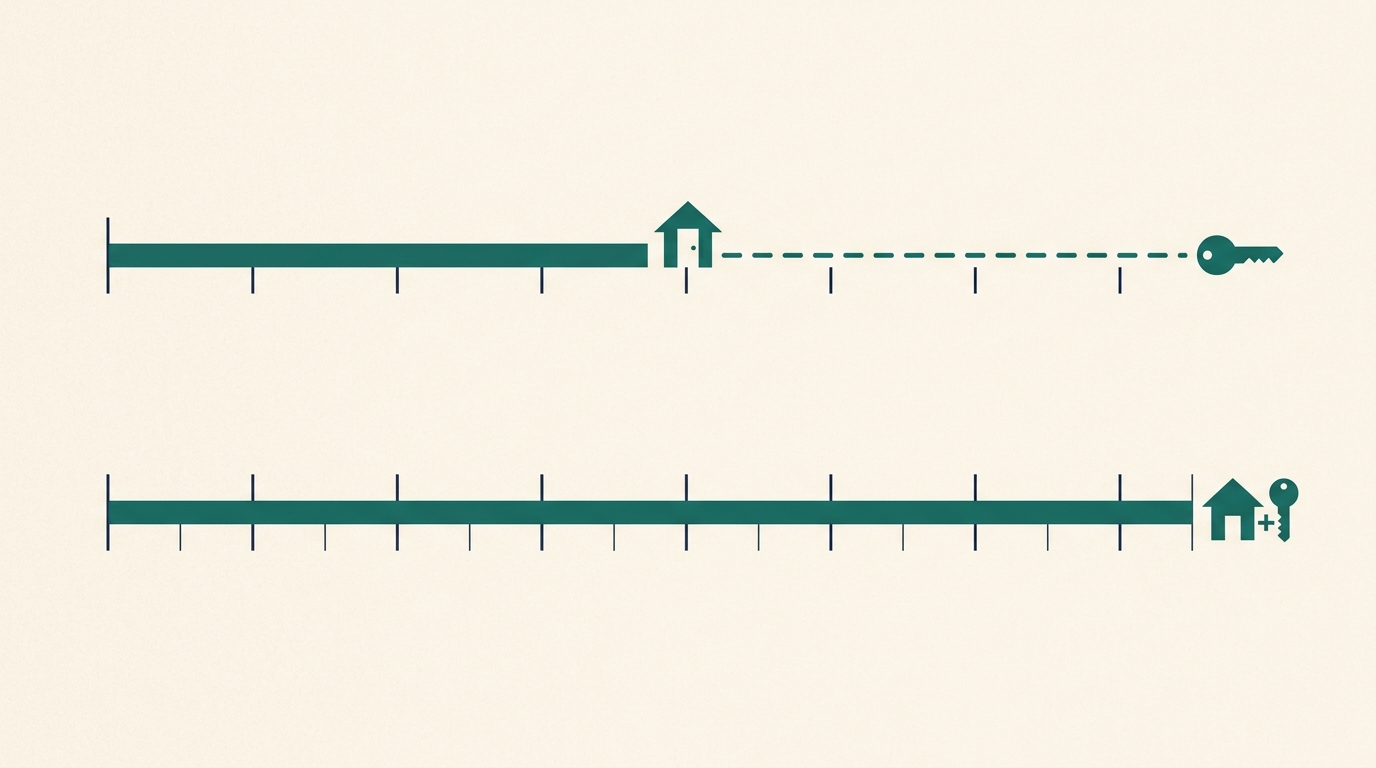
The K-1 reaches U.S. entry first (top, with house icon) but the green card arrives later via adjustment of status (dashed line, key icon). The CR-1 takes longer overall but delivers entry and green card simultaneously (bottom).
The K-1 gets you together faster. The CR-1 gets the green card faster.
If your primary goal is to be physically in the same country as soon as possible, the K-1 has a slight edge — the foreign partner can enter the U.S. while the green card process (adjustment of status) is still pending. But that partner arrives without work authorization, without travel freedom, and with months of additional paperwork ahead.
If your primary goal is to have the foreign partner arrive in the United States as a fully authorized permanent resident — able to work on day one, travel freely, and avoid months of bureaucratic limbo — the CR-1 is the faster path to that outcome. You wait longer for the arrival, but when it happens, you are done.
The 2026 Reality
Both pathways are experiencing backlogs. USCIS processing times have fluctuated significantly in recent years, and embassy interview scheduling varies dramatically by location. The Philippines, Mexico, Colombia, and the Dominican Republic — which together account for the majority of K-1 visas (the Philippines alone had 3,404 K-1 issuances in FY2023, followed by Mexico at 2,096, Colombia at 1,100, and the Dominican Republic at 969, per the U.S. Department of State, FY2023 Report of the Visa Office, Table XV) — often have longer embassy wait times simply due to volume. In 2026, all marriage-based green card applications require in-person interviews, which adds to scheduling pressure.
Check current processing times on the USCIS website and factor in your specific embassy's scheduling patterns when estimating your timeline.
Which Path Costs More?
The K-1 is significantly more expensive than the CR-1. This is one of the most underappreciated differences, because couples often focus on the initial petition filing fee (which is identical) without accounting for the full cost of each pathway.
K-1 Total Cost Breakdown (2026 fees)
| Fee | Amount |
|---|---|
| I-129F petition | $675 |
| DS-160 visa application | $265 |
| Visa Integrity Fee (post-July 2025) | $250 |
| Medical exam (abroad) | $100 - $500 |
| I-485 Adjustment of Status | $1,440 |
| I-765 EAD (work permit) | $260 |
| I-131 Advance Parole | $630 |
| U.S. medical exam (civil surgeon) | $200 - $500 |
| USCIS Immigrant Fee | $220 |
| Total government fees | $4,040 - $4,740 |
Add translation costs, document authentication, travel for the U.S. citizen to visit the fiance, the flight to the U.S., and the marriage license, and the realistic all-in total climbs to $3,000 to $5,000 for a DIY couple — before any attorney fees. For the line-by-line breakdown of every cost stage, including reciprocity fees and embassy travel, see our K-1 visa total cost breakdown.
CR-1 Total Cost Breakdown (2026 fees)
| Fee | Amount |
|---|---|
| I-130 petition | $675 |
| DS-260 immigrant visa application | $325 |
| NVC Affidavit of Support fee | $120 |
| Medical exam (abroad) | $100 - $500 |
| USCIS Immigrant Fee | $235 |
| Total government fees | $1,455 - $1,855 |
With translations, civil documents, and travel, the realistic all-in total for a CR-1 is $1,700 to $2,800 — roughly half to a third of the K-1 pathway. The CR-1 has no Visa Integrity Fee (that fee applies only to nonimmigrant visas), no adjustment of status, no EAD or advance parole, and no second medical exam.
Why the K-1 Costs So Much More

K-1 (left) carries the same base petition fees as CR-1 (right) — but adds a $2,330 adjustment-of-status surcharge (the gold cap) for I-485, EAD, and Advance Parole that the CR-1 path simply does not have.
The difference comes almost entirely from the adjustment of status step — and got dramatically worse after USCIS unbundled fees on April 1, 2024. Before that change, the I-485 cost $1,225 and included the EAD work permit, Advance Parole travel document, and biometrics. After April 2024, USCIS split those out:
| Component | Pre-April 2024 | Post-April 2024 |
|---|---|---|
| I-485 (Adjustment of Status) | $1,225 (bundled) | $1,440 (biometrics only) |
| I-765 (EAD) | Included | $260 separate |
| I-131 (Advance Parole) | Included | $630 separate |
| AOS package total | $1,225 | $2,330 |
That is a 90% increase for the full adjustment package. The CR-1 spouse arrives as a permanent resident, so there is no adjustment of status, no EAD application, no advance parole, and no second medical exam — the entire $2,330 line item simply does not exist for the CR-1 path. That single structural difference, more than any other factor, is why the CR-1 saves couples $1,500 to $2,500 in government fees alone.
Attorney Fees
If you hire an immigration attorney, expect to pay $2,000 to $5,000 for either pathway, though complex cases or attorneys in high-cost-of-living areas can run $5,000 to $15,000. Some attorneys charge more for K-1 cases because the process involves two major phases (the petition and the adjustment), whereas the CR-1 is a single continuous process.
The Interview Comparison
Both the K-1 and CR-1 require a consular interview at a U.S. embassy or consulate in the foreign partner's home country. The format is similar — the foreign partner attends alone, answers questions from a consular officer, and presents supporting documents. But the substance of the interview differs in important ways.
K-1 Interview: Relationship and Intent to Marry
The K-1 interview has a dual focus. The consular officer must determine two things: first, that the relationship between the petitioner and the fiance is genuine — not a sham arranged for immigration purposes. Second, that the couple genuinely intends to marry within 90 days of the fiance's arrival in the United States.
This dual burden means the officer may probe more deeply into the relationship's trajectory and the couple's concrete wedding plans. Expect questions like:
- How and when did you meet? (In-person meetings within the past two years are required.)
- How often do you communicate, and through what channels?
- Have you met each other's families?
- When and where do you plan to get married?
- Have you made any wedding arrangements?
- Where will you live after the wedding?
- How will the petitioner financially support the fiance?
K-1 embassy-level refusal rates have run materially higher than CR-1 in recent years — typically in the 20% to 30% range based on aggregated DOS visa issuance and refusal data, though the State Department does not publish a single global K-1 refusal figure and rates vary significantly by post and country (U.S. Department of State, Visa Statistics — Annual Reports). The higher rate does not mean a quarter of genuine couples are denied. It reflects that K-1 cases face a dual evidentiary burden: the officer must evaluate both the relationship's authenticity and the couple's concrete intent to marry within 90 days. Cases with weak evidence of in-person meetings, minimal communication history, or vague wedding plans are particularly vulnerable.
For a full walkthrough of the K-1 interview experience, see our guide on what happens during a K-1 visa interview.
CR-1 Interview: Genuine Marriage
The CR-1 interview focuses on a single core question: is this marriage genuine? Because the couple is already legally married, the officer does not need to evaluate intent to marry — that has already happened. Instead, the focus shifts entirely to the bona fide nature of the marriage itself.
Expect questions like:
- Tell me about your wedding — where was it, who attended, what was the ceremony like?
- How do you and your spouse communicate when you are apart?
- Describe your spouse's daily routine.
- What are your plans for living together in the United States?
- How do you handle finances as a couple?
- Have you met each other's families? What do they think of the marriage?
CR-1 denial rates are lower than K-1 rates. The marriage itself serves as a strong piece of evidence — it demonstrates that the couple has already made a legal commitment to each other. Combined with a marriage certificate, wedding photographs, evidence of shared finances, and communication records, a well-prepared CR-1 applicant presents a compelling case.
For both visa types, the officer is ultimately trying to answer the same question: is this relationship real? The difference is the lens. For the K-1, the lens is "will they actually marry?" For the CR-1, the lens is "is this marriage genuine?" Having a legal marriage certificate shifts the burden significantly in the applicant's favor.
For detailed practice questions covering both scenarios, see our 77 marriage visa interview questions. And for common mistakes that raise red flags during the interview, review our guide on marriage visa interview red flags.
How Ready Are You?
10 questions. 2 minutes. Get your personalized Readiness Score.
Take the Readiness QuizWhen Should You Choose the K-1?
There is no universally "better" visa. But there are specific situations where the K-1 makes more sense than the CR-1.
You want to be physically together as soon as possible. If the emotional and practical toll of long-distance separation is your primary concern, the K-1 gets your partner into the United States faster than the CR-1 — even though the green card takes longer. For some couples, being in the same country and dealing with paperwork together is far preferable to being apart for an additional 6 to 12 months.
You want to get married in the United States. Maybe your family is in the U.S. and traveling internationally is not feasible. Maybe you want a ceremony at your home church, or a reception with friends who cannot travel abroad. The K-1 allows the couple to marry on U.S. soil — something the CR-1 does not, because the CR-1 requires you to already be married before filing.
Getting married abroad is difficult or impractical. Some countries have complex marriage requirements for foreign nationals — lengthy residency requirements, extensive document legalization, or bureaucratic processes that take weeks. In these cases, marrying in the United States on a K-1 may be the simpler logistical path.
Cultural or religious reasons favor a U.S. wedding. If having the wedding at a specific venue, with a specific officiant, or within a specific community is important to the couple, the K-1 makes that possible.
You have met the in-person meeting requirement within the past two years. The K-1 requires that the couple has physically met within two years before filing. If you have recent visit history with passport stamps, photographs, and travel records, you are in a strong position for the K-1.
When Should You Choose the CR-1?
In many situations — particularly for couples who are already married or who prioritize a smooth post-arrival experience — the CR-1 is the stronger choice.
You are already married. This is the simplest case. If you are legally married, the K-1 is not even an option. The K-1 is exclusively for engaged (unmarried) couples. If you have already tied the knot, the CR-1 (or IR-1, depending on marriage length) is your path.
You want work authorization the day your spouse arrives. For many couples, the ability to work immediately is not just a convenience — it is a financial necessity. The K-1 pathway leaves the foreign spouse unable to work legally for three to six months after arrival (while the EAD is processed). The CR-1 spouse can start a job on their first day in the country.
You want to minimize total cost. The CR-1 saves roughly $1,500 to $2,500 in government fees compared to the K-1, primarily because there is no adjustment of status filing and no Visa Integrity Fee. For couples on a tight budget, this is significant.
You prefer a simpler, one-step process. The CR-1 involves one major government interaction: file the I-130, go through NVC, do the interview, enter with a green card. The K-1 involves two major phases — the petition and entry, followed by a completely separate adjustment of status process. Fewer steps means fewer opportunities for delays, errors, and additional stress.
The foreign spouse wants to travel freely from day one. K-1 entrants cannot leave the United States without advance parole until their adjustment of status is complete — which can take a year or more. This means no trips home to visit family, no international travel for work, and no emergencies abroad without risking the entire immigration case. CR-1 holders face no such restriction.
You can tolerate being apart during processing. The CR-1's biggest drawback is the separation period. If both partners have stable lives in their respective countries — jobs, housing, support systems — and can maintain the relationship through regular communication and periodic visits, the CR-1's longer wait is offset by the dramatically smoother arrival experience.
Common Misconceptions
Immigration forums are full of well-meaning advice that is partially or completely wrong. Here are the myths we see most often.
"The K-1 is faster"
This is the most widespread misconception, and it is only half true. The K-1 gets the foreign partner into the United States faster — that part is accurate. But it does not get them a green card faster. When you account for the full timeline including adjustment of status, the CR-1 often delivers permanent resident status sooner. The K-1 is faster to physical togetherness. The CR-1 is faster to legal status. These are different things, and conflating them leads to bad decisions.
"The CR-1 is only for long marriages"
Wrong. Any legally married couple qualifies for the CR-1, whether you got married yesterday or twenty years ago. The marriage length affects whether you receive a CR-1 (conditional, under two years) or an IR-1 (permanent, two years or older) — but both are available to any married couple with a U.S. citizen petitioner. See our CR-1 vs IR-1 guide for the full breakdown.
"The K-1 is easier to get approved"
The data says otherwise. K-1 visas have an embassy-level refusal rate that runs materially higher than the CR-1 — typically in the 20-30% range based on DOS visa issuance and refusal data, versus the lower single digits to low teens for spousal immigrant visas. The K-1 carries a dual evidentiary burden — the officer must be satisfied that the relationship is genuine AND that the couple intends to marry. The CR-1 already has the marriage as evidence of commitment. A marriage certificate is a powerful piece of evidence that the K-1 applicant simply cannot present.
"You can easily switch from K-1 to CR-1 mid-process"
Technically possible, but practically complex. If you file an I-129F for a K-1 and then get married before the petition is processed, you cannot simply convert the petition. You would need to withdraw the I-129F and file a new I-130 as a married couple — effectively starting the process over. Some couples do this, but it means losing all the processing time already invested. The better approach is to make the K-1 vs. CR-1 decision before you file, not during.
"The K-1 90-day deadline is flexible"
It is not. If you enter the United States on a K-1 visa and do not marry your petitioner within 90 days, you are out of status and must leave the country. There are no extensions, no exceptions, and no grace periods. Take this deadline seriously and have your wedding plans in place before the fiance arrives.
Frequently Asked Questions
Frequently Asked Questions
Making Your Decision
After reading through the full comparison, the decision often comes down to a few key questions about your priorities and situation. Here is a simple framework.
Choose the K-1 if being together in the same country as soon as possible is your top priority, you want to get married in the United States, and you can handle the financial cost and bureaucratic complexity of the adjustment of status process. Understand that your partner will be unable to work or travel for several months after arrival, and plan your finances accordingly.
Choose the CR-1 if you are already married (in which case the K-1 is not an option), you want the simplest and most cost-effective path, your partner needs to work immediately upon arrival, or you want to avoid the restrictions and uncertainty of the adjustment of status period. Understand that you will be apart for the entire processing period, and make sure your relationship can sustain that distance.
If you are not yet married and genuinely torn, consider this: many immigration attorneys recommend the CR-1 for couples who have the option, precisely because it is cheaper, simpler, and delivers a better outcome on arrival. The main reason to choose the K-1 is urgency — the need to be physically together before the CR-1 timeline allows.
Whatever path you choose, thorough preparation for the consular interview is essential. Both visa types require you to demonstrate a genuine relationship, and both carry the stress of a high-stakes government interview. Start with our complete guide to marriage visa interview preparation and practice with the 77 most common interview questions. For couples who want to build confidence with realistic mock interviews, ReadyForVisa's AI interview coach simulates the consular interview experience with questions tailored to your specific visa type and case details.
If you have already received your interview date and need a structured countdown plan, follow our 30-day interview prep plan. And for guidance on building the strongest possible evidence package, read our guide on how to prove a bona fide marriage.
The K-1 and CR-1 are both legitimate, well-traveled paths to building a life together in the United States. Neither is inherently better. The right choice is the one that matches your relationship's circumstances, your financial reality, and your priorities. Make the decision thoughtfully, prepare thoroughly for whatever path you choose, and trust that if your relationship is genuine, the evidence will speak for itself.